Bitcoin Whales Go Defensive While Retail Remains Passive: A Tale of Two Markets
Bitcoin has fallen below the $90,000 level, intensifying speculation that the market may be entering the early stages of a broader bearish cycle. The drop comes as on-chain and derivatives data reveal a notable shift in investor behavior, especially among large holders.
According to a recent CryptoQuant report by Darkfost, whales have become significantly more active on Binance, driving a marked increase in BTC inflows to the exchange. This rise in transfers exceeding 100 BTC suggests that the market’s largest players have begun adjusting their positioning, often a sign of evolving risk attitudes and strategic repositioning.
Meanwhile, Bitcoin has been in a corrective phase for nearly two months, consolidating after its prior rally. This pause has been accompanied by a sharp contraction in Open Interest, which has fallen from $47.5 billion to roughly $29 billion today.
The decline reflects substantial disengagement from speculative positions, whether triggered by cautious profit-taking or by liquidations cascading through the derivatives market.
Whale Defense Intensifies as Retail Investors Remain Passive
Darkfost highlights that the rise in whale inflows—measured using a 90-day average—offers a deeper understanding of the current market mood. This metric shows that major holders are prioritizing protection in an increasingly uncertain environment.
Since Bitcoin’s last all-time high, the average whale inflow to Binance has effectively doubled, now approaching 4,000 BTC. Such an increase is rarely insignificant; it typically reflects hedging, de-risking, or preparing liquidity for active repositioning.
In contrast, inflows from retail investors have remained relatively stable and far less volatile. Their exchange activity has not experienced the same directional surge, suggesting that smaller market participants have not meaningfully adjusted their exposure. This divergence creates a striking behavioral split between investor classes.

While whales shift into a defensive posture—moving coins, reassessing exposure, and potentially preparing for further downside—retail participants appear more passive. This may indicate slower reaction times to macro and on-chain signals or simply lower capital at risk.
Historically, such patterns emerge during transitional phases in the market, when sophisticated holders take early precautionary measures before broader sentiment shifts. The growing contrast reinforces the idea that Bitcoin is navigating a phase where caution dominates among its biggest players.
Bitcoin Tests 200 SMA as Market Searches for Direction
Bitcoin’s 3-day chart shows a decisive shift in momentum, with price breaking below the 50 SMA and 100 SMA after weeks of persistent selling pressure. The failure to hold the $90,000 level pushed BTC into its sharpest correction since mid-2024, and the structure now reflects a market struggling to stabilize. The current candle cluster is forming directly on top of the 200 SMA, a historically significant long-term support zone that often separates cyclical uptrends from deeper bearish phases.
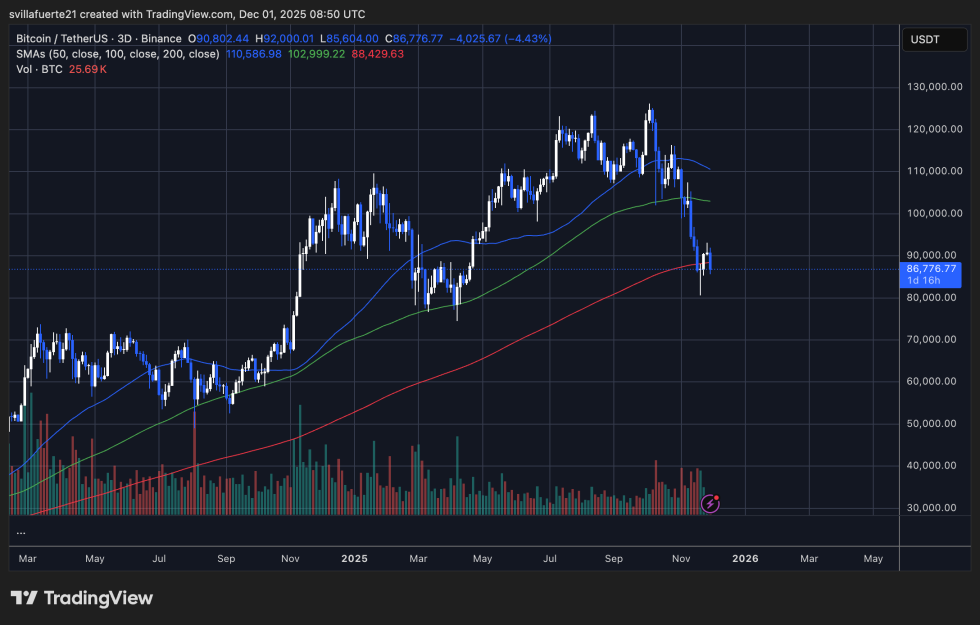
The reaction so far has been mixed. BTC briefly dipped below the 200 SMA before recovering back above it, signaling that buyers are attempting to defend the trend boundary. However, the bounce lacks conviction, and volume remains elevated on down candles—an indication that sellers are still aggressive. As long as BTC trades below the 50 and 100 SMAs, the market structure remains vulnerable.
The downtrend also shows a clear sequence of lower highs and lower lows, confirming that momentum favors continuation unless $92,000–$95,000 is reclaimed. Losing the 200 SMA on a closing basis would open the door to deeper retracements toward $78,000 and $72,000, where prior consolidation zones sit.
Featured image from ChatGPT, chart from TradingView.com
About The Author


