Ripple Scores New Korea Banking Deal With K Bank Partnership
South Korea’s internet-only lender K bank has signed a strategic partnership with Ripple to test blockchain-based overseas remittances, marking another bank-facing expansion for Ripple’s payments infrastructure in Asia.
The agreement, announced Monday by K bank and first reported by The Korea Herald, was signed at the lender’s headquarters in Seoul. K bank CEO Choi Woo-hyung and Ripple Asia-Pacific Managing Director Fiona Murray attended the ceremony alongside officials from both companies.
K Bank Taps Ripple For Blockchain Remittance Tests
The partnership centers on whether Ripple’s global network and blockchain infrastructure can improve the speed, cost efficiency and transparency of K bank’s overseas remittance system. For Ripple, the deal extends its long-running institutional payments strategy into South Korea’s digital banking market. For K bank, it gives the lender a live testing track for blockchain-based cross-border settlement at a time when stablecoins and tokenized payment rails are becoming a more serious part of bank-level infrastructure discussions.
“We are pleased to partner with K bank, which has helped set the standard for digital banking in Korea and continues to drive innovation,” Murray said. “This partnership will help strengthen K bank’s competitiveness in blockchain-based overseas remittance technology,” Choi said.
K bank is already conducting a proof of concept with Ripple for overseas remittances. According to the bank, the first phase tested transfers through a separate application, while the second phase is now assessing transaction stability by virtually linking customer accounts with internal systems. That detail is notable because it suggests the project is moving beyond a standalone test environment and toward a model that examines how blockchain-based remittance infrastructure could interact with bank-side account architecture.
The second phase will also test on-chain transfers with partners in the United Arab Emirates and Thailand. K bank has signed memorandums of understanding in both markets for stablecoin-based transactions, according to the report. That gives the Ripple partnership a broader regional angle: the work is not only about improving a domestic Korean bank’s remittance stack, but also about testing how blockchain rails may function across specific cross-border corridors.
The wallet component is also part of the experiment. K bank used an in-house wallet in the first phase of the proof of concept, but plans to use Ripple’s SaaS-based digital wallet, Palisade, in the second phase. The goal is to test a faster and more scalable model for compliance and deployment, according to the bank.
Notably, Ripple has expanded deeper into stablecoin infrastructure after launching RLUSD in 2024. It has applied for a US trust bank charter, with the approval process still underway.
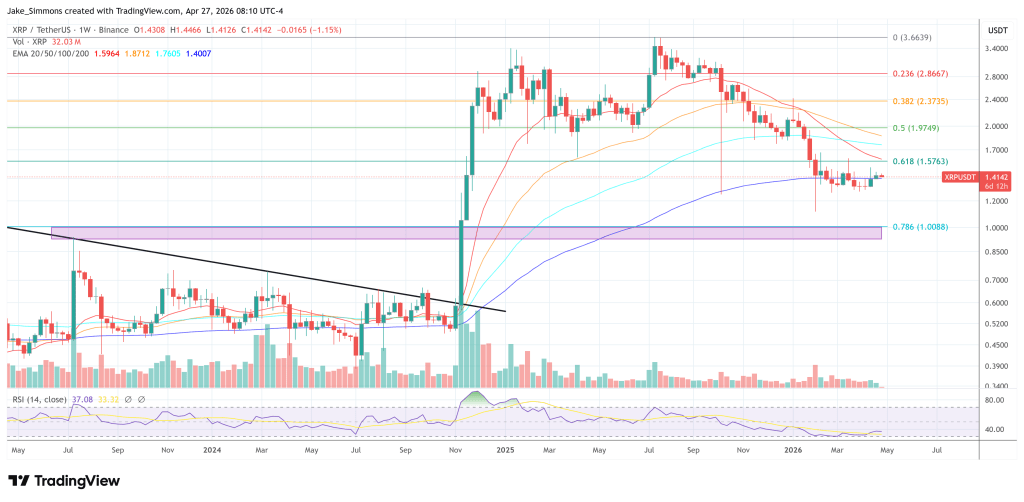
At press time, XRP traded at $1.41.
About The Author


