Institutions Are Buying Bitcoin, But They Are Still Selling Ethereum – Discover What That Split Reveals
Bitcoin has been pushing above key resistance levels while Ethereum struggles to match that momentum — and a CryptoQuant report by analyst MorenoDV has identified a structural reason for that divergence that goes deeper than price action or sentiment. The gap between the two assets is not random. It is being built by the most significant category of market participant in the current cycle.
The report examines Fund Holdings — the total amount of Bitcoin and Ethereum held by institutional investment vehicles, including ETFs, trusts, and dedicated funds. The metric functions as a direct proxy for institutional demand: when fund holdings rise, institutions are adding exposure. When they fall, institutions are reducing it.
Since early February, the data has been telling two very different stories for the two largest crypto assets. Bitcoin fund holdings increased from approximately 1.278 million BTC to 1.370 million BTC — a net accumulation of more than 92,000 BTC, representing 7.2% growth in institutional exposure during a period when the market was recovering from its lows. Over the same period, Ethereum fund holdings moved in the opposite direction — declining from 5.93 million ETH to 5.80 million ETH, a reduction of approximately 127,000 ETH.

The two assets, the same time period, the same category of participant, and opposite decisions. Understanding why that divergence exists and what it means for both assets going forward is where the report’s most significant analytical contribution lies.
Institutions Are Back. They Are Just Not Back for Everything
The MorenoDV report identifies the relationship between fund positioning and price behavior as more than coincidental. In both Bitcoin and Ethereum, price recovery has closely tracked the direction of fund holdings — as institutional positions stabilized and began expanding, prices gradually recovered from their post-crash lows. The sequencing suggests that institutional positioning is not simply reacting to price movements after the fact. It appears to be actively participating in shaping the market structure that determines where prices go.

That observation makes the divergence between Bitcoin and Ethereum considerably more significant. Bitcoin regained institutional confidence relatively quickly — fund holdings expanded by 92,000 BTC while the price rebuilt from its lows. Ethereum has not seen the same dynamic. Fund holdings declined even as the broader market recovered, reflecting a hesitation that the price action has mirrored.
The report’s explanation for that hesitation is structural rather than speculative. Bitcoin has consolidated its identity as the macro reserve asset of the crypto ecosystem — the deepest liquidity, the most developed ETF infrastructure, and the cleanest institutional framework for allocation. Ethereum occupies a different position in the institutional risk hierarchy. During periods of uncertainty, funds have shown a consistent tendency to reduce ETH exposure first while maintaining or rebuilding Bitcoin positions as the comparatively safer allocation.
The recovery that has followed the October crash is therefore not a uniform return of institutional confidence across crypto. It is a selective one, with capital returning to the asset that institutions perceive as the lower-risk entry point first, and the higher-risk allocation waiting for clarity that has not yet fully arrived.
ETH/BTC Remains Under Pressure As Weak Structure Persists
The ETH/BTC pair is trading near 0.0285, continuing to reflect Ethereum’s structural underperformance relative to Bitcoin. The weekly chart shows a clear downtrend that has been in place since mid-2022, defined by consistent lower highs and lower lows. The recent bounce from the 0.019–0.020 region marked a temporary relief rally, but it failed to break the broader bearish structure.
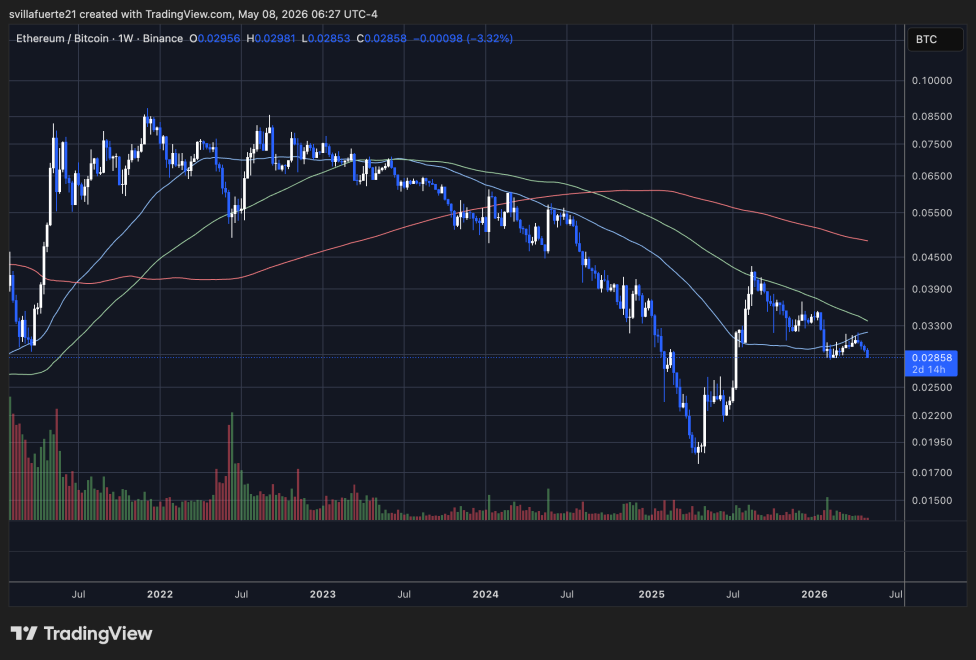
Price is now consolidating below the 50-week and 100-week moving averages, both of which continue to slope downward and act as dynamic resistance. This positioning reinforces the idea that the recovery lacks strength. The 200-week moving average remains significantly higher, near the 0.045–0.050 zone, highlighting how far the pair is from reclaiming a neutral or bullish structure.
The rejection near the 0.035–0.038 region earlier this year is particularly important. That zone now defines the upper boundary of any medium-term recovery attempt. Since then, price has drifted lower, forming a compression pattern just above local support.
If the 0.027–0.028 level fails, the chart opens the path toward a retest of the cycle lows near 0.020. For Ethereum to reverse this trend, it would need to reclaim the 0.035 level with conviction — something the current structure does not yet support.
Featured image from ChatGPT, chart from TradingView.com
About The Author


