America ‘Must Fight To Win Crypto’, Galaxy CEO Novogratz Says
Mike Novogratz has urged Senate Democrats to move forward on crypto market structure legislation, warning that resistance to the CLARITY Act could push digital asset activity further offshore and weaken the United States’ role in shaping the industry.
In a post on X titled “America Must Fight to Win Crypto,” Novogratz framed the debate as both a policy test and a political one for the Democratic Party, which he said risks “hand[ing] the future away” if it allows the bill to stall in the Senate. He said the issue is no longer whether crypto demand exists in the US, but whether American lawmakers will write rules that keep that activity inside the domestic regulatory perimeter.
“I have voted for Democrats most of my adult life, and I will again,” Novogratz wrote. “I am writing this because I root for my party, and because, on the technology that will shape American power in this century, the loudest voices on our left are about to hand the future away.”
Democrats Must ‘Show Up’ On Crypto
The post centers on the CLARITY Act, a House-passed crypto market structure bill designed to establish a clearer federal framework for digital asset markets. Novogratz noted that the legislation passed the House last July with “overwhelming bipartisan support,” including 78 Democrats, but remains stuck in the Senate ten months later.
He argued that the delay is not primarily about policy substance, but political “posture,” pointing to an internal Democratic split over whether legislation that allows crypto firms to operate onshore should be treated as market infrastructure or as a concession to industry.
“A vocal slice of our caucus has decided that any rule letting American crypto companies operate onshore is a corporate giveaway,” Novogratz wrote. “The result is an offshore market.”
To support that claim, Novogratz contrasted the market share of Binance and Coinbase. Binance, which he described as having no formal headquarters but being licensed in Abu Dhabi, clears nearly 40% of global spot volume, while Coinbase, the largest US-based exchange, clears roughly 6%, according to his post. He also cited estimates that 55 million Americans, or one in five adults, own crypto, and that the US accounted for $2.4 trillion in crypto activity in a single year, nearly four times the next country.
For Novogratz, those figures underscore a mismatch between domestic demand and domestic regulatory capacity. His argument is that without legislation, the US will continue to export market structure, liquidity and company formation to rival financial centers such as Singapore, Dubai and London.
But he cast the legislative stakes as larger than exchange activity alone. Tokenization, he argued, could allow American equities, funds, Treasuries and brands to reach global users who may never open a US brokerage account. In that framing, the CLARITY Act is not merely a crypto bill, but a channel for projecting US financial infrastructure abroad.
“Tokenization on public blockchains lets American equities, American funds, American Treasuries, and American brands reach billions of people abroad who will never open a US brokerage account,” he wrote. “CLARITY could make it possible. It is a projection of American power that both Democrats and Republicans should want.”
Novogratz also tied the issue to voter realignment. He said the voters most enthusiastic about crypto include young men, Black men and Latino men, groups he argued Democrats are already struggling to retain. He pointed to Senator Ruben Gallego and Representative Ritchie Torres as examples of Democrats engaging with crypto policy because their constituents are asking about it.
The broader critique was aimed at what Novogratz described as a tendency among parts of the party to litigate rather than build. Citing Ezra Klein and Derek Thompson’s “Abundance,” he argued that Democrats cannot claim to believe in government while failing to make it function on technologies central to economic competition.
“The center of the ring is being contested in real time, by builders and regulators and rival capitals,” Novogratz wrote. “We do not get to opt out. Pass the CLARITY Act. Show up.”
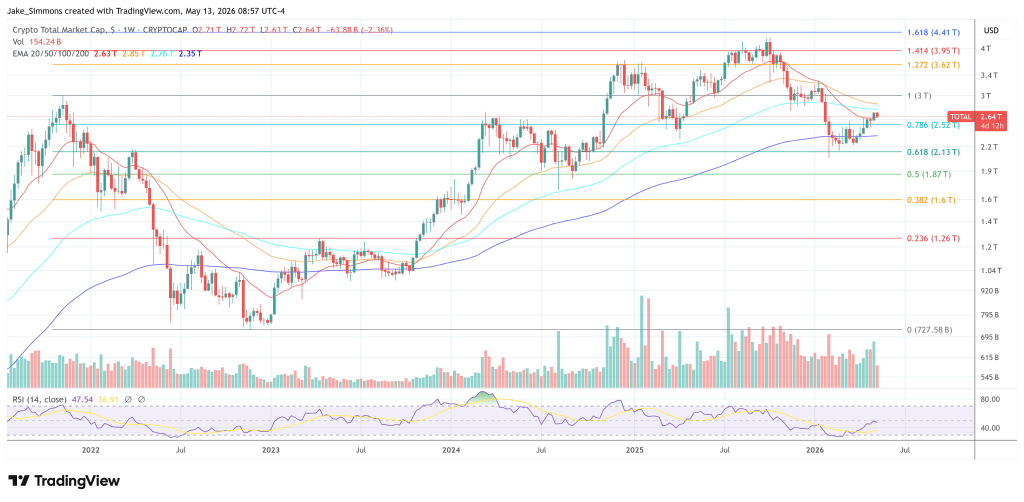
At press time, the total crypto market cap stood at $2.64 trillion.
About The Author


